52-Week Savings Challenge: 3 Ways to Fit Your Paychecks
52 week savings challenge: see the $1,378 weekly plan, a flat biweekly option, and a $1,950 paycheck example with deposits you can compare against bills.
By Ultimate Budget Planner by Cosmo Suite · Editorial policy
Published · 8 min read
General information, not financial advice.
A 52-week savings challenge is a savings schedule with one planned deposit for each week of the year. The classic version starts at $1 and adds a dollar each week, so the final deposit is $52. The full sequence adds up to $1,378, and the later weeks ask for more cash than the early ones.
That rising pace can be a poor match for a month when rent, utilities, or holiday bills already use most of a paycheck. You can keep the same yearly total with a flat biweekly deposit, or set a smaller total that fits your actual pay schedule. The useful version is the one you can track without losing sight of bills due before the next check.
Key Takeaways
- The classic challenge saves $1,378 by adding the week number in dollars, from $1 in week one to $52 in week 52.
- A flat $53 from 26 biweekly paychecks reaches the same $1,378 total.
- A smaller paycheck-sized plan can use the same 26-deposit tracker. For example, $25 each check totals $650.
- Use the cash that arrives in each month, then note the due dates that come before the next payday.
The Classic Challenge Gets More Expensive as the Year Goes On
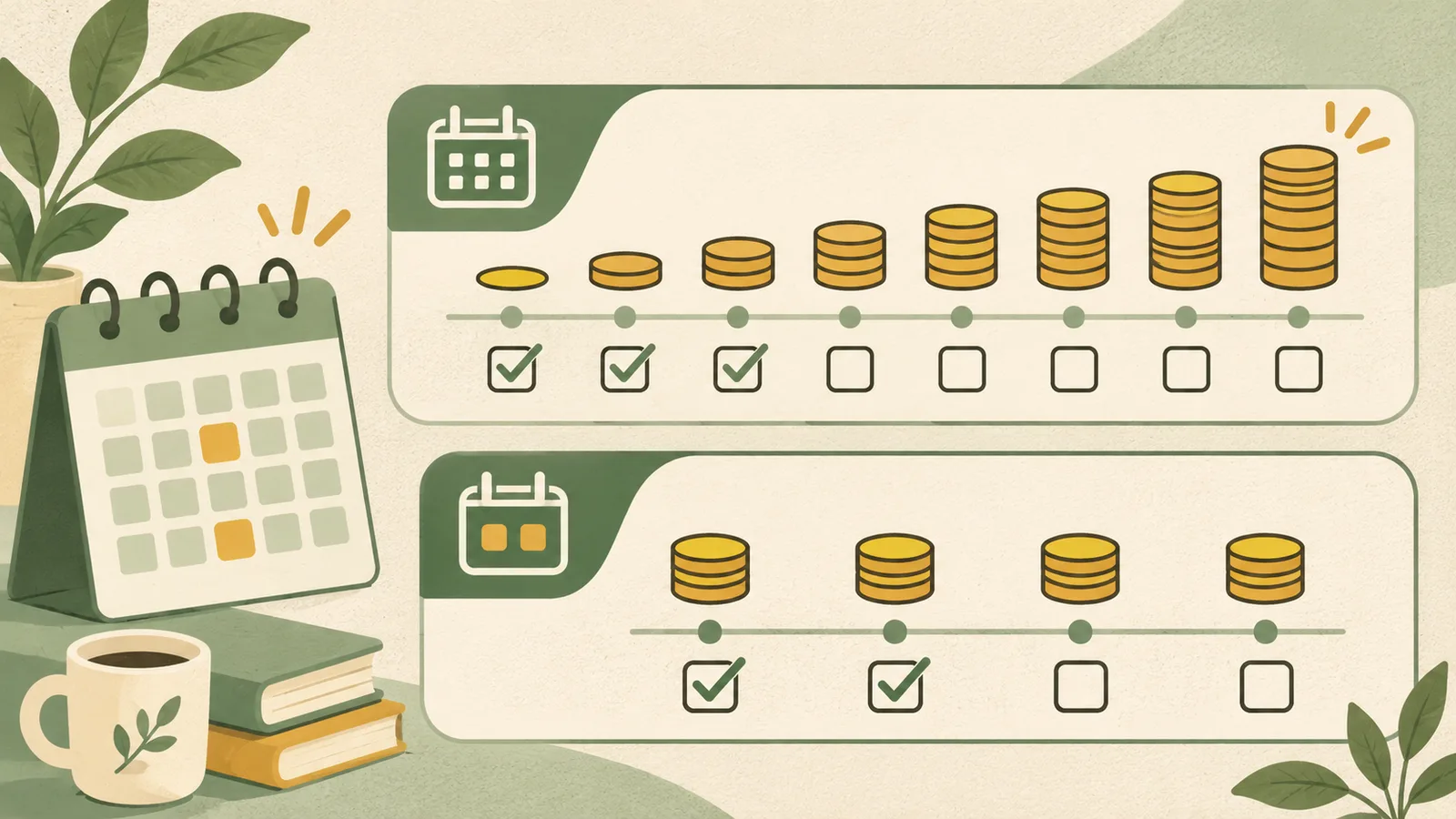
The 52-week savings challenge gradually raises each deposit, which makes the opening weeks light and the final weeks heavier. In the standard version, the deposit equals the week number: $1 in week one, $2 in week two, and so on through $52 in week 52.
The arithmetic is the sum of the integers from 1 through 52: 52 × 53 ÷ 2 = $1,378. Fidelity's 52-week money challenge guide gives the same total. Simmons Bank's printable challenge and Regions Bank's challenge sheet show the same week-by-week pattern.
The week number makes the schedule easy to follow, but the amount changes each time. Week one calls for $1; week 26 calls for $26. The last 13 deposits run from $40 to $52, for $598 across those weeks. The first 13 total $91. That puts more than six times as much in the final quarter as in the first.
If your cash is tighter later in the year, reverse the order and start at $52, then step down to $1. The total stays $1,378, with the largest deposits at the beginning. A paycheck-based budget spreadsheet can help you compare those deposits with bills due around each payday.
52-Week Savings Challenge: The Decision Table
Choose the schedule by matching its deposit timing to your paydays and the amount you can set aside after bills.
| Version | Deposit schedule | Total after 52 weeks or 26 checks | Best for |
|---|---|---|---|
| Classic weekly | $1 in week 1, rising by $1 to $52 | $1,378 | Someone who prefers a small start and can handle larger year-end deposits |
| Reverse weekly | $52 in week 1, falling by $1 to $1 | $1,378 | Someone who has more room now and wants smaller deposits later |
| Paycheck-based | $53 from each of 26 checks for $1,378, or $25 from each for $650 | $1,378 or $650 | Someone paid every two weeks who prefers the same amount from each check |
The classic and reverse weekly plans preserve the $1,378 goal. The paycheck-based plan can keep that target at $53 per check or use a smaller target, such as $650 at $25 per check. Both totals are arithmetic for hypothetical deposits, not recommendations for what you should save.
The Worked Month
Imagine a household that receives $1,950 every other week. In a two-check month, $3,900 arrives. A $53 challenge deposit from each check would set aside $106 that month. A $25 version would set aside $50.
| Money in | Money out | Left |
|---|---|---|
| Two $1,950 take-home checks | No expenses entered | $3,900 |
| No additional cash | Two $53 challenge deposits | $3,794 before bills and other spending |
| No additional cash | Two $25 challenge deposits | $3,850 before bills and other spending |
Spread over a year, 26 checks of $1,950 average $4,225 a month. That average is not the cash that arrives in a two-check month. A third paycheck can land in some months. Plan from the dates and amounts that actually arrive, and keep the challenge amount beside the bills that must clear before the next deposit.
Three Schedules Use the Same Tracker in Different Ways
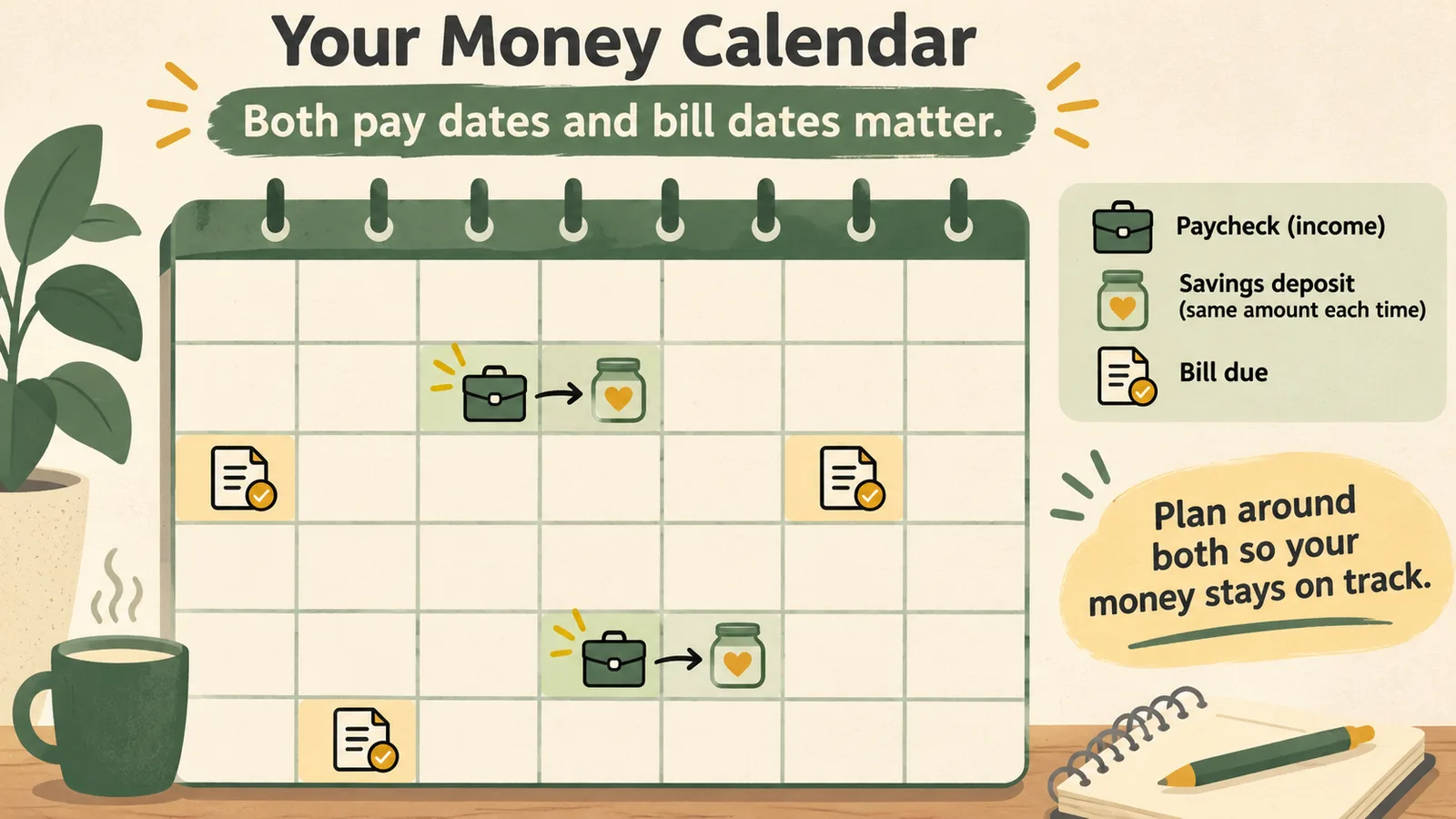
You can track every version with four fields: planned deposit, deposit date, amount actually set aside, and running total. The row for a deposit should move only when money is set aside, so the running total does not get ahead of your account.
For the classic schedule, list weeks 1 through 52 and use the week number as the amount. Add each amount to a running balance. The first few entries are small, but the final entries need more room in the monthly plan. Before starting, look at the late-year weeks as well as the first month.
For a reverse schedule, use the same rows and total, but count down from $52. The reverse version keeps the $1,378 total and moves the largest deposits to the beginning. Compare those early amounts with near-term bills before choosing it. Regions Bank describes both increasing and decreasing versions in its challenge handout.
For a flat biweekly schedule, divide the classic total by 26: $1,378 ÷ 26 = $53 per check. Write the 26 expected payday dates in the tracker and keep the planned amount constant. If the target feels too high, choose a smaller amount and multiply it by 26. For instance, $25 per check totals $650, while $40 per check totals $1,040.
If your pay is weekly, you can use the classic 52-row schedule directly. For twice-monthly pay, count the actual paydays in your chosen year. Twice-monthly pay usually has 24 scheduled pay dates, so $1,378 divided by 24 is about $57.42 each time. Rounding each deposit can change the total; if you want to preserve exactly $1,378, make the final deposit the remaining amount.
A weekly budget template with a paycheck view can help you line up a weekly deposit with the money available that week. For a broader view of planned and actual amounts, see the budget spreadsheet guide.
Put the Savings Date After the Bills You Need to Cover
Set the challenge deposit after you know which bills must be paid from that check. A challenge tracker records the goal. Your budget calendar shows which bills need that cash first.
Suppose rent is due two days after payday and utilities are due the following week. Those dates matter more than the challenge's week number. Mark the bills first, then choose a challenge date after the necessary cash is accounted for. If an amount would leave the account short before the next check, lower that deposit or move it to a later date.
Consumer.gov recommends gathering bills and pay stubs, listing monthly income and expenses, then checking planned spending against actual spending at month-end. Use the same steps to choose a target and review challenge deposits against the money that arrives. The Consumer.gov guide to making a budget explains that monthly routine. The Google Sheets budget template guide shows a customizable layout if you want to build a tracker in a spreadsheet. A 52-week challenge can use that kind of simple schedule without treating its total as the right goal for every household.
If you have an uneven paycheck, use the amount you can safely set aside for that pay period rather than forcing the same number each time. Label the deposit as planned, adjusted, or skipped. That small note helps you tell the difference between a schedule change and money already moved.
A Missed Deposit Is a Schedule Change You Can Record
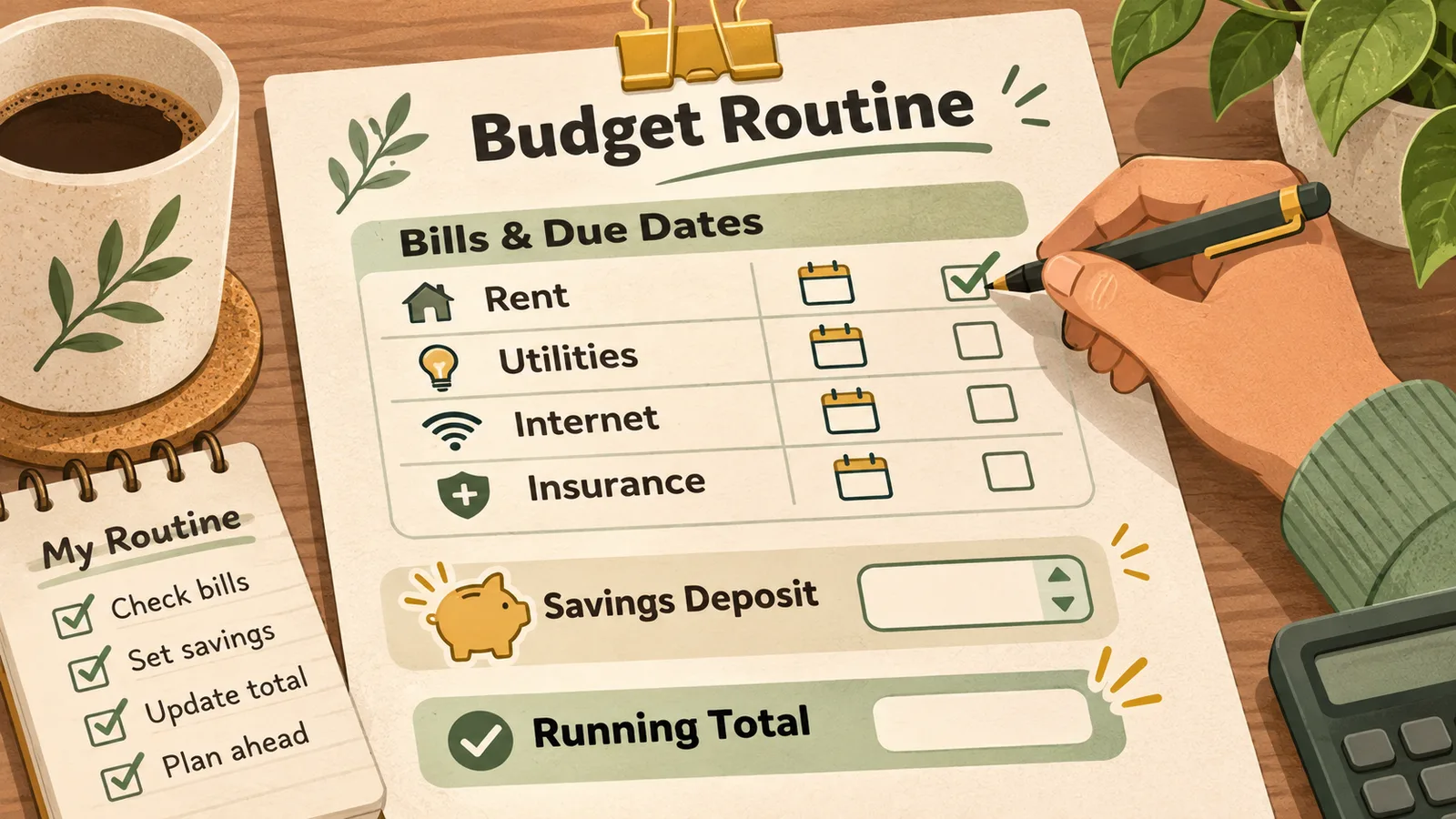
When you miss a deposit, write down what happened and choose how to handle it. You can skip that amount, divide it across later paydays, or extend the end date. The tracker should reflect the amount actually set aside.
Do not add a missed amount on top of a later deposit without checking the new total. If week 18's $18 was skipped, adding it to the next planned $19 would make that deposit $37. The running total should increase by $37 only after that amount is actually moved. If $37 does not fit, leave the original schedule adjusted and continue with an amount that works.
You can also lower the target. If you switch from $53 to $25 per biweekly check, your planned total becomes $650 over 26 checks. If you change halfway through, add the deposits already made to the new deposits still planned. That gives you a current goal rather than measuring yourself against the original schedule.
Fidelity notes that the traditional challenge can be adjusted if its increasing weekly amounts are hard to maintain. Use your own tracker to make the change visible. A clear plan is easier to follow than a schedule that no longer matches your paydays.
Why Trust This Article
Ultimate Budget Planner by Cosmo Suite makes the budget spreadsheet described below. The $1,378 figure is the sum of deposits from $1 to $52, which Fidelity, Simmons Bank, and Regions Bank also show. The table compares the two weekly orders, the same total spread across 26 checks, and a smaller example. No interest or household completion data is included. The editorial policy explains how this site handles sources and corrections. The $3,900 two-check month, $4,225 annual monthly average, and the $25 paycheck-sized example are illustrative calculations using $1,950 take-home checks. The linked source pages were checked on November 14, 2026. This article explains budgeting mechanics and is not financial advice.
Where the Ultimate Budget Planner Fits
A savings challenge can live on paper, in a bank's printable tracker, or in your own spreadsheet. If you want its deposits alongside bills and paycheck dates, compare the file's contents with the way you prefer to budget.
The Ultimate Budget Planner spreadsheet for monthly and paycheck planning has 28 tabs across four sections and is available in Excel and Google Sheets. It includes monthly budget tabs and a Paycheck Dashboard. The product contents do not claim a dedicated 52-week savings challenge tracker, so you would need to record challenge deposits in a suitable budget category or another tracker you already use.
A spreadsheet requires manual transaction entry. If you want bank syncing, reminders, or frequent phone updates, an app may fit better. If you are comfortable entering transactions yourself, the Ultimate Budget Planner budget workbook can keep a planned savings amount beside monthly spending and paycheck timing.
Frequently asked questions
How much money do you save with the 52-week challenge?
The classic version adds $1 in week one, $2 in week two, and continues through $52 in week 52. The deposits total $1,378 before any interest or fees.
How much do I save each week in the 52-week challenge?
In the classic version, the weekly deposit matches the week number: $1 in week one, $2 in week two, and up to $52 in week 52. The amount rises by $1 each week.
Can I do the 52-week savings challenge every two weeks?
Yes. One equal-deposit version divides $1,378 by 26 pay periods, which is $53 from each biweekly check. You can also set a smaller total and divide it by 26.
Can I start a 52-week savings challenge at any time?
Yes. Week one can begin whenever you choose. Use 52 deposits rather than tying the schedule to January, and write down your first date so the final deposit is easy to find.
What if I miss a week of the savings challenge?
Mark the missed amount and decide whether to skip it, spread it across later deposits, or extend the end date. Keep the tracker aligned with what you actually set aside.
How can I make the challenge fit my paycheck?
Choose an amount that leaves room for bills and planned spending, then multiply it by the number of deposits you expect. For example, $25 from each of 26 biweekly checks totals $650.
Sources
Keep reading
Savings and Net Worth
Sinking Fund: Turn Five Yearly Bills Into $179 a Month
Sinking fund: turn five yearly bills into one $179 monthly amount, and see the March dip that leaves a fund started in January short of cash.
· 8 min read
Savings and Net Worth
How to Save for a House Down Payment Without Guessing at the Goal
how to save for a house down payment with a target, timeline, and paycheck plan. Separate the down payment from closing costs and cash you need to keep.
· 9 min read
