Sinking Fund: Turn Five Yearly Bills Into $179 a Month
Sinking fund: turn five yearly bills into one $179 monthly amount, and see the March dip that leaves a fund started in January short of cash.
By Ultimate Budget Planner by Cosmo Suite · Editorial policy
Published · 8 min read
General information, not financial advice.
A $540 insurance bill lands in March. The budget balanced, rent was paid and groceries were covered. The bill was not in it.
A sinking fund is money you set aside in small, regular amounts for a cost you know is coming, so the bill is already paid for when it arrives.
Without one, the bill is a surprise for one of three reasons. It comes twice a year, so it never sat on the monthly list. Or it sat on a yearly list with no money behind it. Or the money was set aside in the same account as everything else, and it was spent by April.
Here is how to size a fund, a worked year with the March dip most guides skip, and where to keep the money.
Key Takeaways
- Divide each yearly cost by 12, add the results, and move that amount every month.
- Five yearly costs totaling $2,148 need $179 a month, or $83 a paycheck if you are paid every two weeks.
- A fund started in January with $0 is short in March. A $100 starting balance covers the gap.
- A sinking fund is for costs you can predict. An emergency fund is a separate balance.
A Predictable Bill Is a Surprise Only Without a Monthly Share
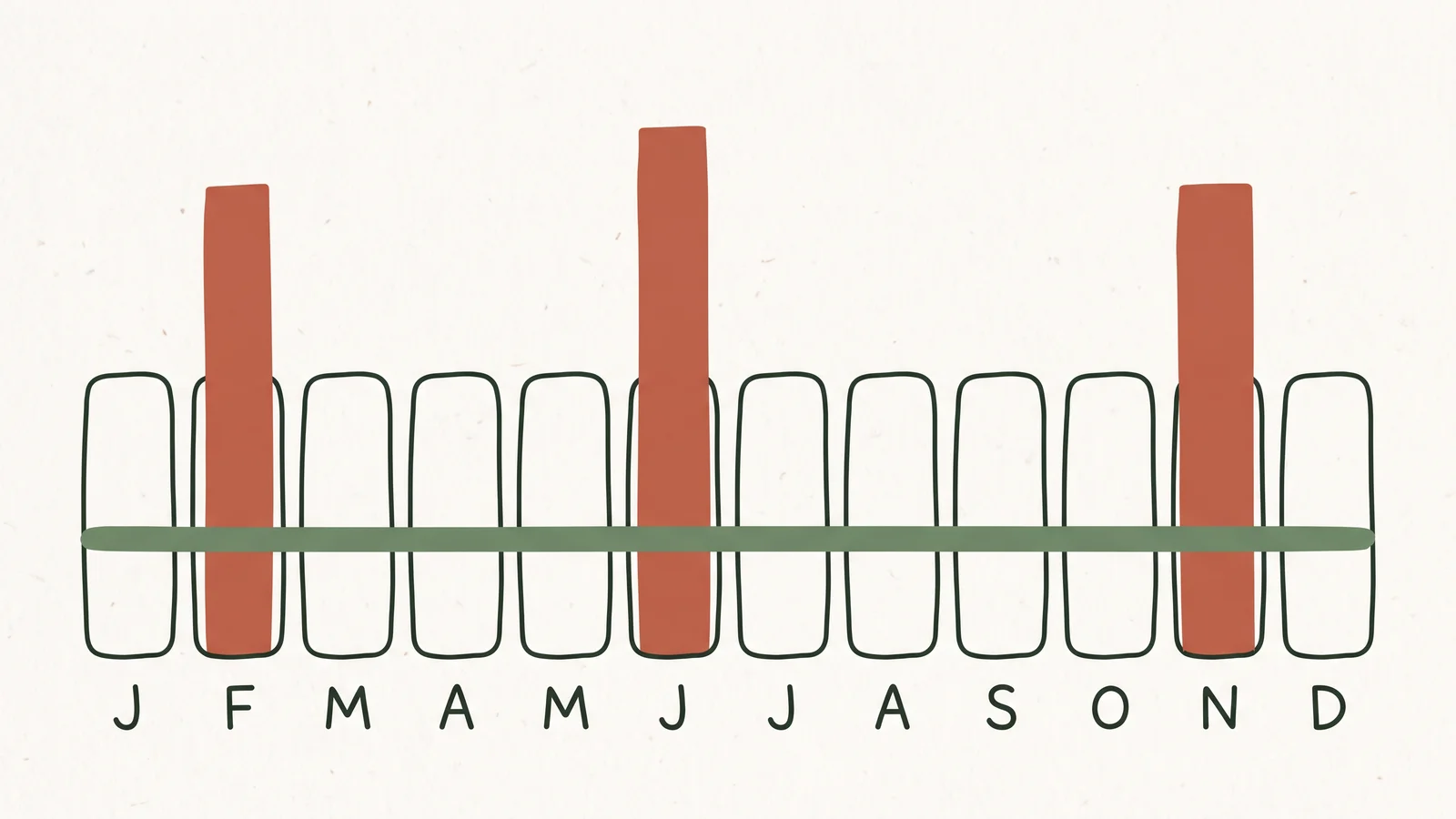
In fact, a car registration, a 6-month insurance premium and a round of holiday gifts are not emergencies. You can read the date and the amount off last year's statement. In other words, they feel like emergencies only because the monthly budget has no line for them, so the money has to come from whatever is left that week.
For example, the CFPB's spending checklist gives the fix in one sentence: look back over several months so you do not miss less frequent expenses such as insurance payments, medical expenses and gifts. Those costs are the whole raw material for a sinking fund. The CFPB's bill calendar tool makes the same point from the bill side: figuring out which bills to expect helps you plan to have enough money on hand.
Notably, the search term can mislead you. In corporate finance, a sinking fund repays a bond. This post is about the household version, which is simpler: a monthly amount, a purpose and a due month.
Take any yearly cost and divide it by 12. Its monthly share is the slice of a bill that belongs to this month. Move the share every month, and consequently the cost stops landing on one paycheck. A budget spreadsheet that lists every recurring bill with its frequency is one place to keep those shares.
Sinking Fund: The Decision Table
Pick where the money sits by how easily you spend what you can see. That matters more than what looks neat, because the setup only works if it survives a bad week.
| Where the money sits | How it works | What it costs | Best for |
|---|---|---|---|
| One savings account per fund | Each bill has its own account or bucket, and you move money in each payday | Usually free; more accounts to watch | Someone who spends any balance they can see in checking |
| One savings account, funds tracked in a list | All the money sits together; a list shows what each fund holds | Usually free | Someone who will keep a list current |
| Lines in the budget file only | The money stays in checking; the file shows what is earmarked | Nothing | Someone who trusts themselves not to spend it |
| Cash envelopes | Physical cash set aside for small, local costs | Nothing | Haircuts, school fees and other cash-only costs |
| A budgeting app with fund buckets | The app tracks each bucket from a bank login | A subscription, billed monthly or yearly | Someone who wants bank sync and will pay for it |
The middle two rows suit most households. A list is cheap, and one account is easy to open and leave alone. That said, the risk with a list is that the money sits in checking, where a bad week can spend it. In particular, if that has happened to you before, use the first row.
The Worked Month
Imagine a household paid $1,950 every other week, on the 9th and the 23rd. Those two checks put $3,900 into the month. Nine monthly bills total $1,974, with rent of $1,350 among them, and groceries run $520.
| Money in | Money out | Left this month |
|---|---|---|
| Two $1,950 take-home checks, 9th and 23rd | Nothing entered yet | $3,900 |
| No additional cash | $1,974 for nine monthly bills | $1,926 |
| No additional cash | $520 for groceries | $1,406 |
| No additional cash | $179 moved to the sinking fund | $1,227 |
Specifically, the last line is the sinking fund, the only line that is not owed to anyone. You pay it to your future self so that March, June and December stay quiet. All the numbers are illustrative.
Five Yearly Costs Turn Into $179 a Month
Start by listing every cost that arrives less often than monthly. For each, multiply the amount by its frequency, then divide by 12. The frequency is the number of times a cost arrives in a year (1 for yearly, 2 for every 6 months).
| Cost | Amount | How often | Monthly share |
|---|---|---|---|
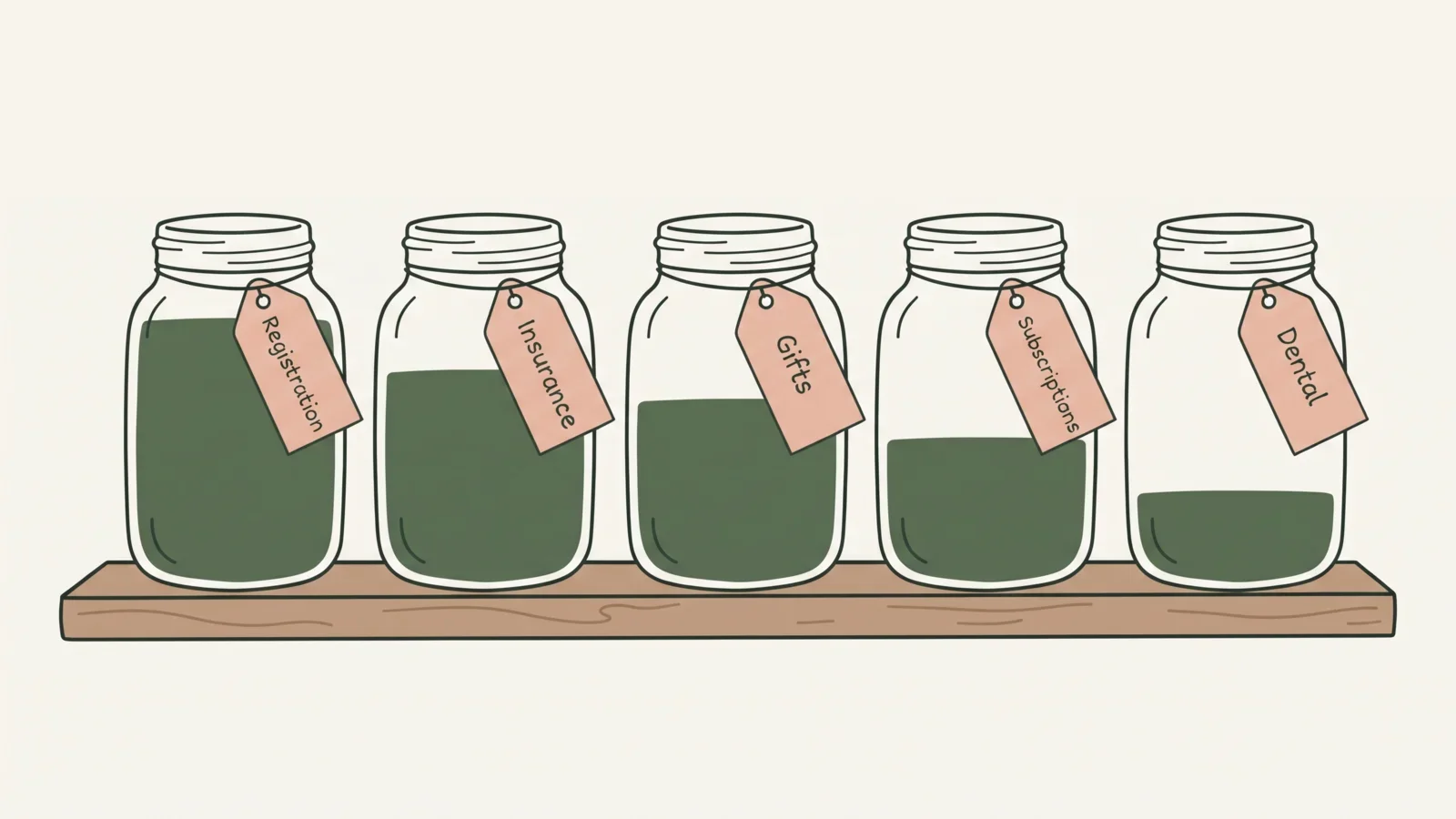
| Vehicle registration | $168 | Yearly | $14 |
| Insurance | $540 | Every 6 months | $90 |
| Holiday gifts | $600 | Yearly | $50 |
| Annual subscriptions | $120 | Yearly | $10 |
| Dental cleanings | $90 | Twice a year | $15 |
| Total | $2,148 a year | $179 |
This list is an illustrative example built line by line. Every total here can be recomputed from the amounts above.
For instance, read the second row twice. The bill is $540, but it arrives twice, so the year costs $1,080. Dividing $540 by 12 would therefore leave the fund $540 short every year. The frequency column matters more than the amount column, and the seven bill frequencies cover nearly every cost on your own list.
Alternatively, if you are paid every two weeks, you can divide by 26 instead. $2,148 divided by 26 is $82.62, so rounding up to $83 a paycheck puts in $2,158 across the year, $10 more than needed. The two months with three paydays then add $249 rather than $166, which is a decent use of an extra check.
A Fund Started in January Is Short in March
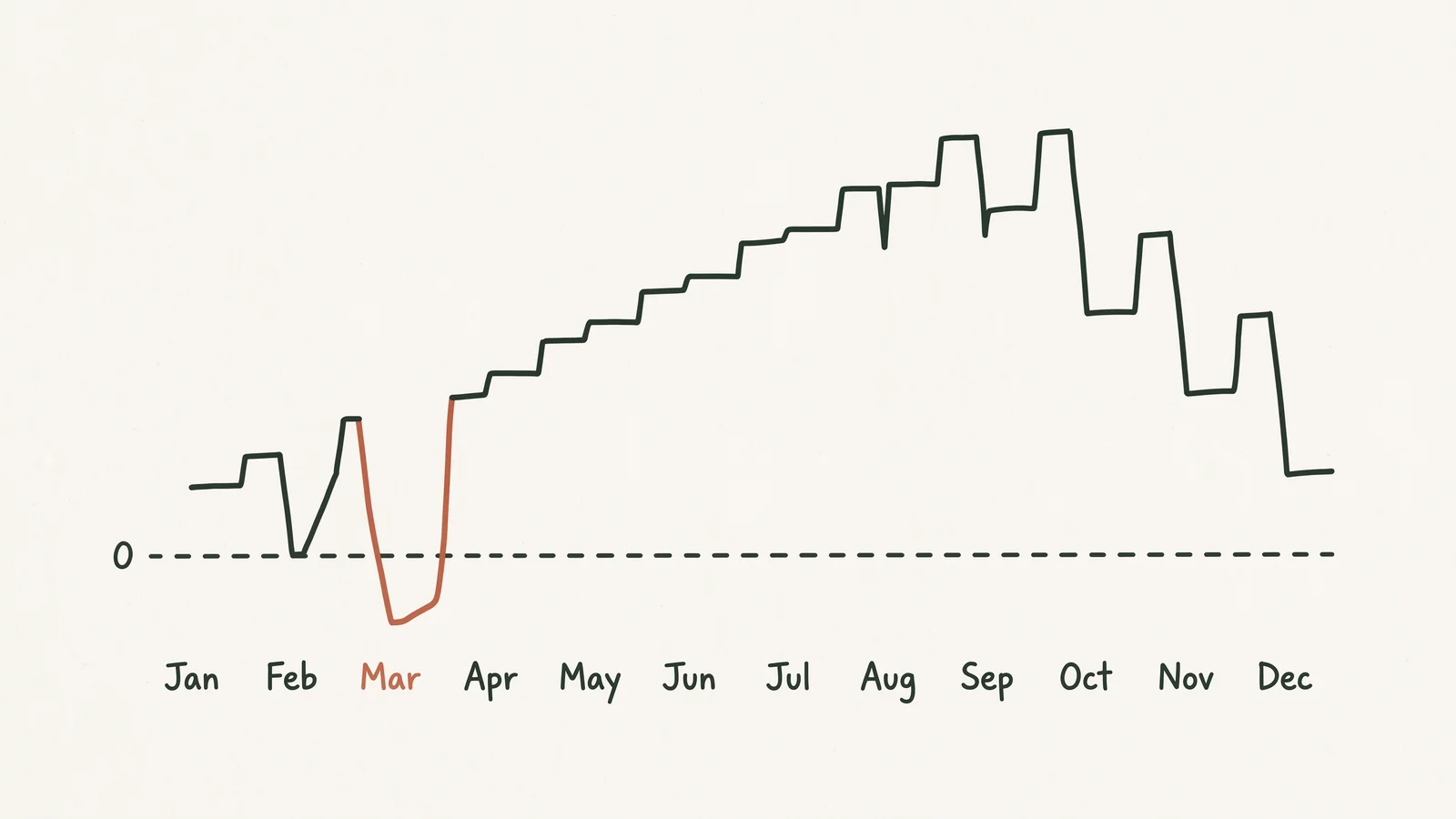
The monthly amount is the same all year. The balance is not, because the bills do not arrive evenly. Here is the same fund, with $179 added at the start of each month and each bill paid in the month it arrives.
| Month | Put in | Bills paid | Balance after |
|---|---|---|---|
| Jan | $179 | None | $179 |
| Feb | $179 | Dental $90 | $268 |
| Mar | $179 | Insurance $540 | -$93 |
| Apr | $179 | None | $86 |
| May | $179 | None | $265 |
| Jun | $179 | Registration $168 | $276 |
| Jul | $179 | None | $455 |
| Aug | $179 | Dental $90, subscriptions $120 | $424 |
| Sep | $179 | Insurance $540 | $63 |
| Oct | $179 | None | $242 |
| Nov | $179 | None | $421 |
| Dec | $179 | Gifts $600 | $0 |
The year ends at exactly $0, which is the sign the arithmetic is right. However, March is the problem: three months of $179 is $537, and the bill is $540 plus the $90 dental visit before it. The fund is $93 short.
Most guides stop at "divide by 12". A fund started cold in January cannot pay a March bill. The first year therefore needs a starting balance equal to the deepest dip. Here that is $93, which rounds to $100. The starting balance is the cash the fund holds before its first monthly amount arrives. With a $100 start the balance never drops below zero, and it ends the year at $100.
Meanwhile, you have three ways to cover the dip: a starting transfer, a few larger payments in the first months, or moving the due date of the first bill. The first is the cleanest.
An Emergency Fund Is a Separate Balance
Similarly named, a sinking fund and an emergency fund can sit in the same bank, but they are different jobs. The CFPB's guide to emergency funds describes emergency savings as money for expenses that are not part of your routine monthly spending. A 6-month insurance bill, however, is a routine cost. It just arrives less often.
Mixing the two causes one predictable failure. A flat tire spends the gift money, and as a result December is the surprise. Give each balance its own name, even if the bank shows one account.

What Keeps a Sinking Fund Running
Most sinking funds fail from missed transfers, and the sums are rarely the cause. Thus a few habits matter more than the exact amount.
- Move the money on payday. Importantly, if it waits until the end of the month, it is whatever is left, and nothing is left. Pay the fund first, the way you pay rent.
- Name each line after its bill. "Insurance, Mar and Sep" tells you when it is needed and how it is spent. "Savings 2" does not.
- Round up to the whole dollar. An amount like $82.62 invites errors. $83 is easier to set once and leave.
- Re-run the list at each renewal. An insurance premium that rises from $540 to $580 adds $80 a year, or about $7 a month.
- Look back several months. Last year's statements find the costs you forgot, which is the CFPB's advice above.
If you would rather not rebuild that list every year, a budget spreadsheet where each recurring bill carries its own frequency starts from the same rows.
Why Trust This Article
We are the Cosmo Suite team that makes the Ultimate Budget Planner, a spreadsheet for budgeting. Our editorial rule is that every total can be recomputed from the amounts shown, and each figure was fact-checked against its source before this went live. They are illustrations, not data from a customer. The CFPB ideas come from the three pages named under the article, checked on 23 November 2026. We built the worked year above line by line. We sell a budget spreadsheet, so check that a fund suits your own bills before you rely on it, and contact us through the site if a figure looks wrong. This is general information, not financial advice.
Where the Ultimate Budget Planner Fits
The sum is easy. The hard part of a sinking fund is remembering which bills arrive twice a year, when, and what the monthly share is this year.
The Ultimate Budget Planner is a budgeting spreadsheet for Excel and Google Sheets. Its Build Your Wealth section includes a Sinking Funds tab, next to 50/30/20, Net Worth and the Debt Calculator. Recurring items take one of seven frequencies, from weekly to yearly, and you tick each one when it is paid.
Because it is a file, not a bank-linked service, it does not connect to your bank, and as a result you move the monthly amount yourself. The file shows the plan. For some readers that is a drawback. In contrast, an app with bank sync fits them better. For readers who do not want a bank login or a yearly fee, it keeps the plan in a file they own.
If you want to see how the monthly view and the sinking fund fit together, the budget spreadsheet guide walks through the layout, and the 50/30/20 rule shows where a fund sits inside a take-home split.
Frequently asked questions
How much should I put in a sinking fund each month?
Divide each yearly cost by 12 and add the results. A $540 insurance bill every 6 months is $1,080 a year, or $90 a month. Five yearly costs that total $2,148 need $179 a month. If you are paid every two weeks, divide the yearly total by 26 instead. That is $83 a paycheck, rounded up.
Is a sinking fund the same as an emergency fund?
No. A sinking fund pays for a cost you can predict, such as a 6-month insurance bill. The CFPB describes emergency savings as money for expenses that are not part of your routine monthly spending. Keep two separate balances, so a gift budget never quietly turns into a car repair.
Why is it called a sinking fund?
The name comes from finance, where money is set aside to pay off a debt on a set date, so the debt sinks. Households borrowed the name for the same habit: money put aside until a known date. In a household budget the term has nothing to do with bonds.
Should a sinking fund have its own bank account?
It depends on how easily you spend money you can see. A separate savings account keeps the balance out of checking, which helps if the money is tempting. One account plus a tracking list in your budget file works if you trust the list. Pick the setup you will still follow in June.
What if I can't afford the full monthly amount?
Start smaller. Fund the largest bill first, such as insurance at $90 a month, and add the next fund once the first runs smoothly. A partial amount still shrinks the surprise when the bill arrives, and that is the whole job of the fund. Raise the amount at your next raise or renewal.
How many sinking funds do I need?
As many as you have costs that arrive less often than monthly. Count them from last year's statements: insurance, registration, gifts, subscriptions, medical visits. Five costs need five lines, but the lines can share one account. More lines only help while you can still name what each one is for.
Sources
Keep reading
Savings and Net Worth
52-Week Savings Challenge: 3 Ways to Fit Your Paychecks
52 week savings challenge: see the $1,378 weekly plan, a flat biweekly option, and a $1,950 paycheck example with deposits you can compare against bills.
· 8 min read

Savings and Net Worth
How to Save for a House Down Payment Without Guessing at the Goal
how to save for a house down payment with a target, timeline, and paycheck plan. Separate the down payment from closing costs and cash you need to keep.
· 9 min read
