How to Budget by Paycheck (and Still Track the Month)
Budget by paycheck: map each bill to the check that arrives before it is due, budget the $3,900 two-paycheck month, and keep the monthly total in view.
By Ultimate Budget Planner by Cosmo Suite · Editorial policy
Published · 11 min read
General information, not financial advice.
Your income covers the month on paper, and the first week still feels short. Rent leaves on the 1st, the next deposit lands on the 9th, and the gap is paid with money you had already promised to something else. Three causes cover almost every case. The bills and the paydays sit on different dates. Sometimes the month is treated as one pot when it arrives in two. And a bill due before payday may never have been assigned to the check that could cover it.
All three are date problems. A paycheck budget is a plan that gives each incoming check a job before the next one arrives, and it sits beside the monthly view rather than replacing it. A budget spreadsheet that runs the paycheck cycle and the month from one entry keeps both views on the same numbers. Here is the mapping, the arithmetic for 26 checks a year, and the two months that hold three paydays.
Key Takeaways
- A paycheck budget assigns bills and spending to the check that arrives before they are due.
- Biweekly pay produces 26 checks a year, so two months hold three paydays and ten hold two.
- Budget the $3,900 that lands in a two-paycheck month, not the $4,225 monthly average.
- A bill due before payday belongs to the earlier check or to money set aside, never to hope.
A Paycheck Budget Fixes Timing, Not Income
A paycheck budget leaves your income and your bills alone. It changes only the order in which the two meet.
A paycheck budget is a plan that assigns each bill and each spending amount to the check that arrives before it is due. Take-home pay is the amount that reaches your account after payroll deductions, and it is the only number a spending plan can use. A pay period is the interval between two paydays, and its length decides how many checks a year holds.
The Consumer Financial Protection Bureau makes the timing point directly. Its bill calendar guide says to list every bill with its amount and due date, then check the list each week, because the timing of your income and expenses may be off. That sentence is the whole reason this method exists.
A monthly total hides the sequence. Two households with the same $3,900 in and the same $2,091 of bills can have very different months, depending on whether the rent date falls before or after the first deposit. If you want the bill side built first, the monthly bill tracker layout lists every bill once with its frequency and its send date, and it is the natural companion to this plan. If the tight week has become every week, the guide to leaving paycheck-to-paycheck covers the income side.
Budget by Paycheck: The Decision Table
Pick the view by the question you are trying to answer this week, not by the tool you already own.
| View | The question it answers | What it needs from you | Best for |
|---|---|---|---|
| Paycheck view | Will the bills be covered before the next deposit? | Real pay dates and real due dates | Anyone whose bills land before payday |
| Monthly view | Where did the money go this month? | Every transaction, entered once | Comparing the plan with what happened |
| Both, side by side | Will this bill be covered, and does the month still balance? | One set of entries feeding both | A household that wants one number it can trust |
| Neither, and a rough guess | Nothing precise | Nothing | The month where the 1st is short |
The two views answer different questions, and neither one replaces the other. The paycheck view looks at the next fourteen days. The monthly view looks at the last thirty. Keeping both on one set of entries costs a few minutes a week and takes the guesswork out of the tight week.
The Worked Month
Take one earner paid $1,950 every two weeks, on the 9th and the 23rd. Ten months a year hold two of those checks, which is $3,900 of cash. Eleven bills are due, counted at their monthly share, and groceries run $520.
| Money in | Money out | Left this month |
|---|---|---|
| Two $1,950 checks, 9th and 23rd | Nothing entered yet | $3,900 |
| No additional cash | $1,493 of bills due from the 23rd to the 8th: rent, renters insurance, internet, gym, streaming, car registration | $2,407 |
| No additional cash | $598 of bills due from the 9th to the 22nd: phone, car insurance, car payment, electric, water | $1,809 |
| No additional cash | $520 of groceries across the month | $1,289 |
[Original data] The table is an illustrative example built line by line, not a customer's data, and every total can be recomputed from the bills listed below.
Read the first two lines together. Rent of $1,350 falls on the 1st, which is before either check in this month arrives, so it comes out of the previous month's second check. Nothing has gone wrong there. It is the reason the plan needs a cycle view alongside the calendar one.
Two Pay Cycles, Not One Calendar Month
A biweekly schedule does not divide evenly into months, and the arithmetic that follows from that is where most paycheck budgets quietly break.
The IRS pay-period table in Publication 15-T sets out the counts: 52 weekly periods, 26 biweekly, 24 semimonthly, 12 monthly. Twenty-six periods is two more than twenty-four, and those two extra checks decide whether the plan holds or runs short twice a year.
A smoothing reserve is money set aside in a three-paycheck month so the two-paycheck months can carry the average. The monthly average here is $1,950 × 26 ÷ 12 = $4,225. No month pays $4,225. Ten months pay $3,900, which is $325 short of the average, and two months pay $5,850, which is $1,625 above it. Ten times $325 is $3,250, and two times $1,625 is $3,250. The reserve closes the gap only if the extra checks fund it.
So the cycle is the unit. Cycle A runs from the 9th to the 22nd. Cycle B runs from the 23rd to the 8th of the next month. Each cycle holds one deposit of $1,950. Each holds its own set of bills.
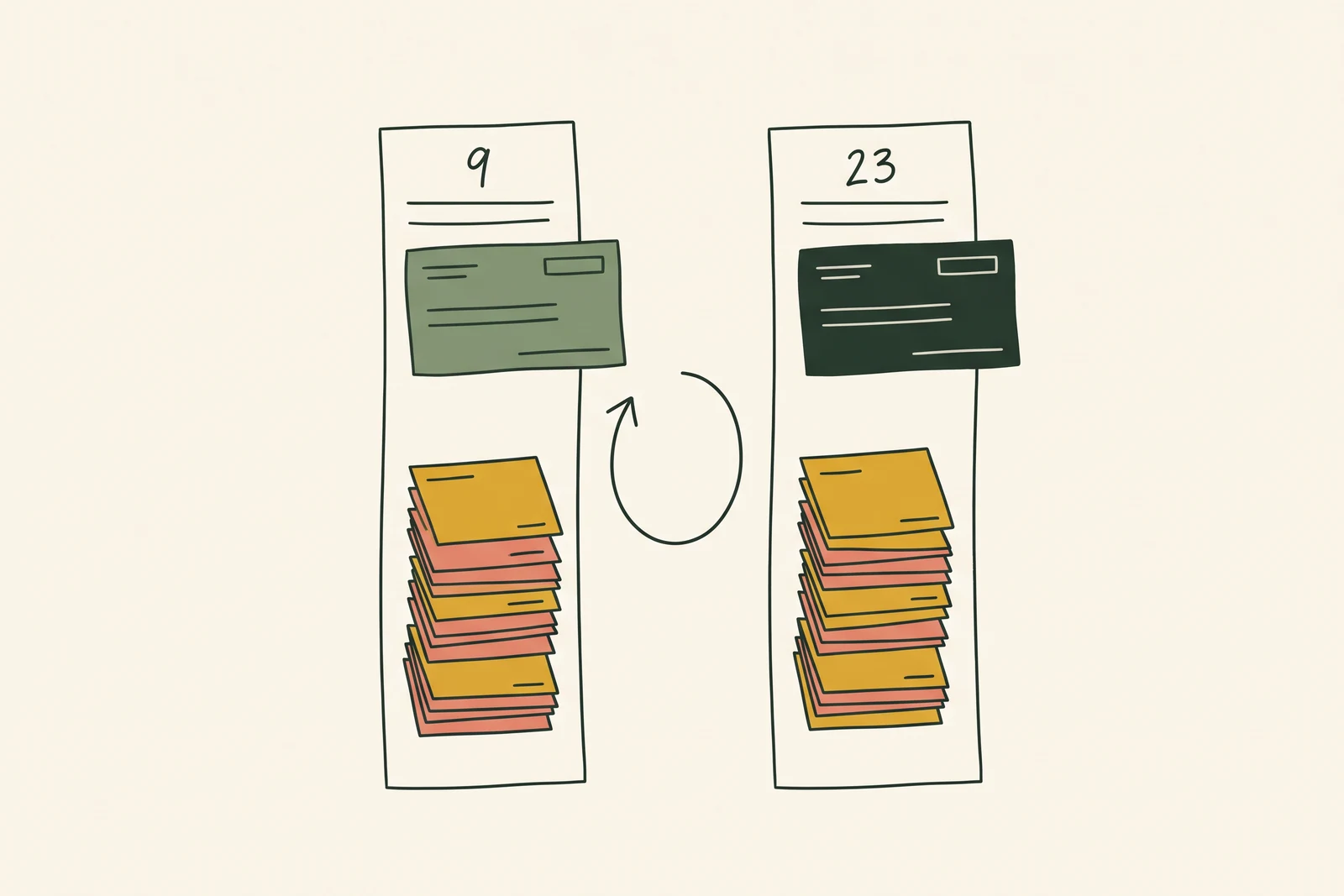
[Unique insight] The two extra biweekly checks are the money that funds the ten months paying $325 less than the average. Spend them as a windfall and the plan comes up $3,250 short over a year.
A semimonthly schedule behaves differently again. Twenty-four checks of $1,950 is $46,800 a year, and every month holds exactly two, so the cycle and the month line up. If your pay arrives on the 15th and the last day, the monthly view is already a cycle view, and the reserve step is unnecessary.
Map Every Bill to the Check That Arrives Before It
The mapping takes one pass. Write each bill with its amount and due date, then draw a line at each payday. Every bill above a line belongs to the check below it.
| Cycle | Bills due in it | Total | Left after bills and $260 of groceries |
|---|---|---|---|
| B, 23rd to the 8th | Rent $1,350, renters insurance $18, internet $65, gym $30, streaming $18, car registration $12 monthly share | $1,493 | $197 |
| A, 9th to the 22nd | Phone $45, car insurance $105 monthly share, car payment $310, electric $96, water $42 | $598 | $1,092 |
The B cycle is the tight one, and the rent explains most of it. A cycle that leaves $197 after bills and groceries is workable, but there is no room in it for a car repair. Cycle A leaves $1,092, which is where the cushion lives.
When a bill lands on the wrong side of the line, the first move is a phone call. The CFPB's guide to adjusting bill due dates suggests putting due dates and income dates side by side and asking billers to move a date, noting that some are willing to change one on request. A gym bill moved from the 24th to the 20th moves from cycle B to cycle A, and $30 of pressure leaves the tight fortnight.
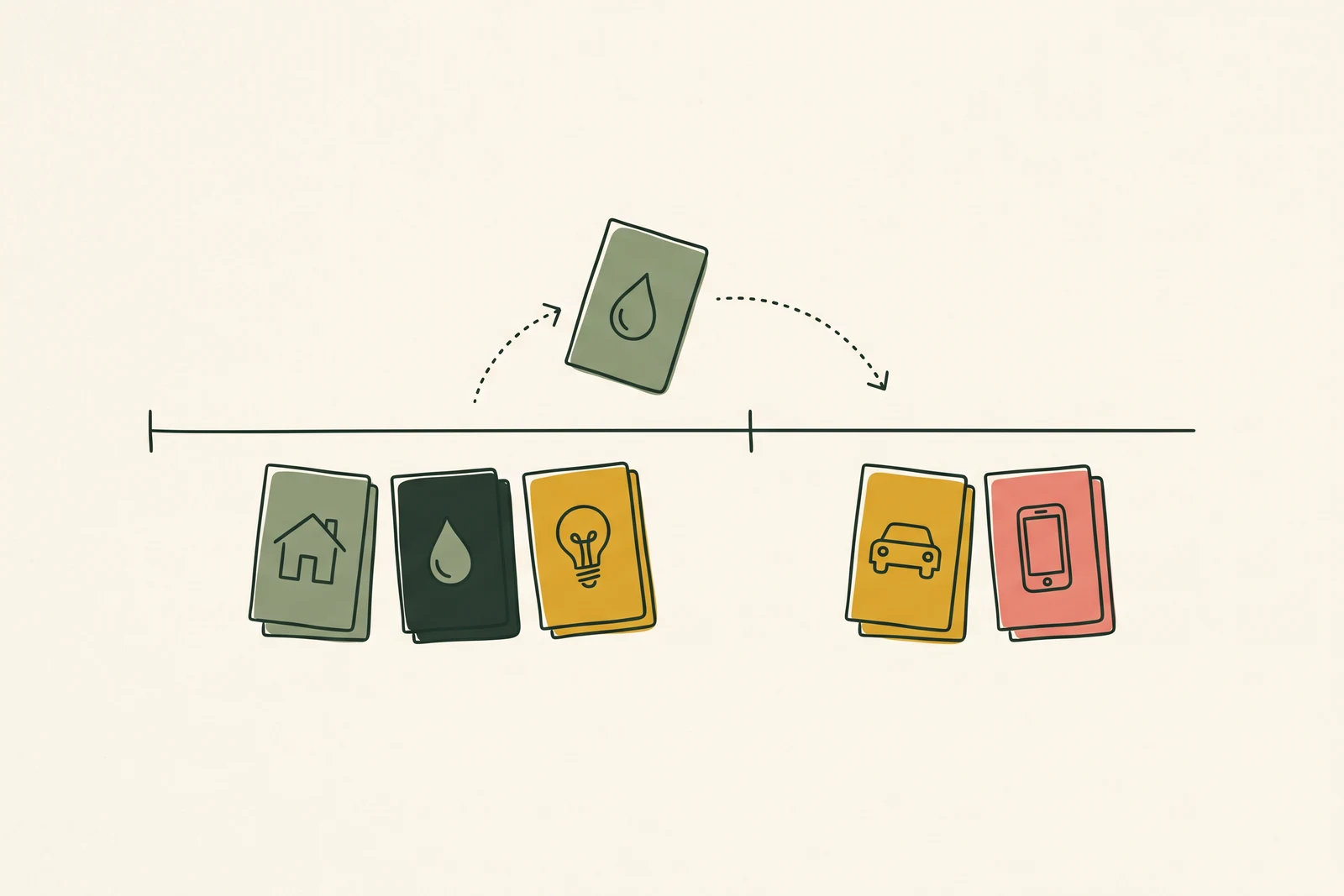
The second move is a sinking fund. A sinking fund is money set aside each month for a bill that arrives later. Car insurance at $630 every six months is $105 a month, and that monthly share is already inside cycle A. A yearly list adds money that no cycle row holds. Gifts at $480, a subscription at $96 and registration at $144 come to $720 a year, which is $60 a month. The $12 registration share is the only part already in the bills. The remaining $48 a month is what a sinking fund carries. Keeping those amounts in the cycle where the bill falls, rather than in the month it is paid, is what stops a $630 charge from landing on a $197 fortnight.
A Third Paycheck Arrives Twice a Year
Two months a year hold three biweekly paydays. In this example that is $5,850 of cash, and the extra $1,950 arrives with no bill attached to it.
There are three sensible uses, and the order matters less than the decision. The first is to refill the smoothing reserve, which is the $3,250 a year the two-paycheck months draw on. The second is to fund a sinking fund that has been running behind, such as the car insurance or the holiday list. The third is to leave it unassigned until the next cycle review, which is a legitimate choice for anyone whose income varies.
Treating it as a raise is the mistake. A budget built on $5,850 fails in the ten months that pay $3,900, and the failure looks like a spending problem when the arithmetic caused it.
If the check is not certain to arrive, do not count it before its pay date. The consumer.gov guide to making a budget handles this case for irregular income by adding up last year's income and dividing by twelve, which produces a number you can plan on rather than a number you hope for.
When the Pay Changes From Check to Check
Hourly work, tips and freelance income all break the fixed-check assumption. The method survives; the entry changes.
Start each cycle with the amount you can confirm, list the bills due inside it, and leave the rest unassigned until it lands. The CFPB's cash-flow budget worksheet does exactly this on a weekly grid: write the beginning balance for the week, add the income received in that week, subtract the week's expenses, and carry the ending balance into the next week. The carry-forward is the part that matters, because it turns four uncertain weeks into one running number.
Run that worksheet for six weeks before you set a plan. Six weeks covers three biweekly cycles or six weekly ones, which is enough to see the low week and the high week rather than an average that describes neither.
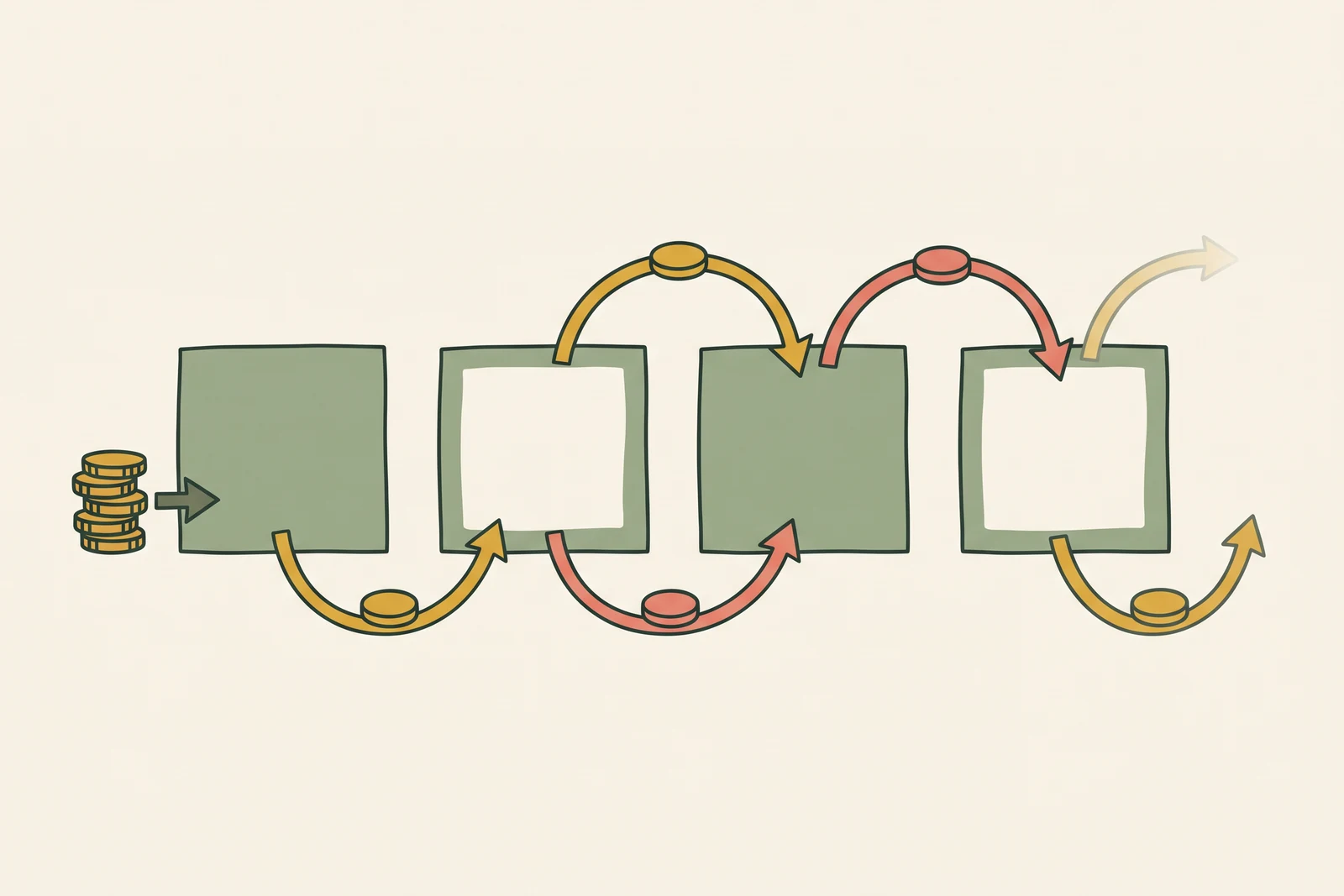
When the low week is known, it can be planned for. A bill that lands in the low week moves to the high week, or a small buffer sits in the account to carry it. The buffer does not need to be large. In the example above, cycle B leaves $197, so a $300 buffer would remove the tightness entirely. That is less than the $325 gap between the monthly average and the cash a two-paycheck month holds.
The Part Most Guides Leave Out: the Month Still Runs
The paycheck view plans the next fourteen days. It does not record the month, and a plan with no record drifts within about six weeks.
The fix is to reconcile once a month. Add the two cycles together and compare the total with the monthly view. In the worked example, $598 plus $1,493 is $2,091 of bills, $520 of groceries, and $1,289 left from $3,900. If the monthly view says something different, one of the two is wrong. The gap is usually a bill entered twice or a subscription that renewed unnoticed.
A budget spreadsheet with the cycle and the month already connected does this reconciliation without a second entry, which is why the cycle rhythm suits biweekly pay better than a calendar month. The budget spreadsheet guide compares what a sheet, an app and a paper list can each carry, and a weekly budget template with a paycheck view does the same job on paper, one week at a time.
One more habit is worth the two minutes. At the end of each cycle, write the ending balance on the next cycle's first line. That single number tells you whether the plan is holding, and it costs less effort than any review meeting.
Why Trust This Article
We are the Cosmo Suite team that builds and sells the Ultimate Budget Planner, so we have a stake in this topic. The method works in any spreadsheet, including one you build from a blank sheet.
Methodology: the worked month is an illustrative example built in the planner's own tabs, not a customer's data, and every total can be recomputed from the lines shown. The pay-period counts come from IRS Publication 15-T, the weekly carry-forward worksheet from the Consumer Financial Protection Bureau, and the bill-timing guidance from the CFPB and consumer.gov. All five sources were checked on 21 November 2026.
Read more about us and our editorial policy, or contact us through the site footer. Verify the dates against your own pay stubs and statements before you act on any number.
Where the Ultimate Budget Planner Fits
The mapping is the easy part. The hard part is keeping the cycle view and the month view on the same entries as pay dates shift and a bill moves.
The Ultimate Budget Planner is that wiring already built, in one file for Excel and one for Google Sheets. It has 28 tabs in 4 sections. The Dashboards section holds a Paycheck Dashboard for weekly, bi-weekly, semi-monthly or custom cycles, so the two cycles above are a setting rather than a second sheet. The 12 Monthly tabs run beside it, starting in any month and carrying over or running zero-based, and the same transaction feeds both.
The Transactions section is where the entries live: Easy Setup, Bank Accounts, Recurring Transactions, Payments and Variable Transactions. A bill is entered once in Recurring Transactions with one of 7 frequencies, each generated date is ticked when paid, and the Payments tab records what left the account. The Automated Calendar puts those dates on their due days, and Annual Totals collects the year.
The Build Your Wealth section carries the parts that do not fit a single month: Sinking Funds for the yearly list, a 50/30/20 view, a Debt Calculator, Net Worth, an Investment Forecast and a No-Spending Challenge. Up to 6 users can work in the same file.
It is $9 one-time for both formats, reusable every year, with no subscription. A ready-made budget spreadsheet with the paycheck dashboard and the 12 Monthly tabs in one file removes that setup pass, and its bill list starts from the same recurring entries the tracker layout uses.
Frequently asked questions
Is it better to budget by paycheck or by month?
Use both, and give each one a different job. The paycheck view answers whether the bills due before the next deposit are covered. The monthly view answers where the money went over thirty days. One set of entries can feed both.
How many paychecks do I get in a year?
It depends on the schedule. The IRS pay-period table in Publication 15-T lists 52 weekly periods, 26 biweekly, 24 semimonthly and 12 monthly. Biweekly pay therefore produces two months a year with three paydays, and the rest with two.
What do I do when a bill is due before payday?
Assign it to the earlier check or to money already set aside for it. If the same bill is short every cycle, ask the biller whether the due date can move to the other side of your payday. The CFPB notes that some are willing to change a date on request.
Should I budget from the monthly average or from each check?
Plan from each check, and keep the average for reference. A $1,950 biweekly check averages $4,225 a month, but no month pays that. Ten months pay $3,900, so a flat $4,225 budget is $325 short ten times a year unless a reserve covers it.
How do I budget by paycheck when my hours change every week?
Start each cycle with the pay you can confirm, list the bills due inside it, and leave the rest unassigned until it arrives. A weekly cash-flow worksheet carries each ending balance into the next week, which shows the low week and the high week before you commit to a plan.
Can one spreadsheet show the paycheck view and the month at once?
Yes, if a single entry feeds both. A Paycheck Dashboard set to a weekly, bi-weekly, semi-monthly or custom cycle can sit beside 12 Monthly tabs in the same file, so a bill entered once appears in the cycle and in the month without being typed twice.
Sources
- Consumer Financial Protection Bureau, Budget help: manage your monthly expenses with a bill calendar
- Consumer Financial Protection Bureau, Adjusting your bill due dates can help you stay on top of your bills and manage your cash flow
- Consumer Financial Protection Bureau, Creating a cash flow budget (Module 5 worksheet)
- Consumer Financial Protection Bureau and FDIC, Making a budget
- Internal Revenue Service, Publication 15-T (2026), Federal Income Tax Withholding Methods
Keep reading
Bills and Paychecks
Monthly Bill Tracker: Six Columns and Seven Frequencies
Monthly bill tracker: copy a free six-column layout, enter each bill once with its frequency, and see what is due before the next paycheck.
· 11 min read
Bills and Paychecks
Gross vs Net Income: Which Figure Belongs in Your Budget?
Gross vs net income can show very different pay amounts. Learn which figure to use in a household budget, what deductions mean, and how to read a pay stub.
· 8 min read
Bills and Paychecks
Average Monthly Expenses: What the U.S. Data Shows
Average monthly expenses in the U.S. were about $6,545 in 2024. Compare category averages, see income-group differences, and check your own month.
· 7 min read
